

How To Get To Sofria Aqueduct
In 1904, the inadequacy of the Los Angeles River as a water supply for the growing city's 175,000 people came to a head. For ten direct days that summer, water consumption in Los Angeles exceeded river capacity by more than iv million gallons (about xv,141,647 liters). Finding an alternative water source became a top priority, and with an affluence of water simply outside the city, aqueducts proved to be the answer.
Specifically, the water engineers in L.A. settled on the Owens River Valley, due to several principal factors. First, Owens Lake received a tremendous corporeality of snow runoff from the Sierra Nevada Mountains, to the point of alluvion. 2d, lava from a volcanic eruption had blocked the lake'due south tributary, pregnant it could no longer release its water into the river system. All of that water, to the people tasked with finding more water for L.A., was going to waste matter. And third, before that volcanic eruption, the Owens h2o had flowed most straight into 50.A.
And then L.A. went about building a 226-mile (364-km) aqueduct to conduct water from Owens Valley into the city [source: LADWP]. The methods developed in aboriginal Rome stood the test of time, and the L.A. engineers constructed undercover pipes and siphons to deliver h2o past way of gravity. Some of the pipes are large enough to accommodate a car. The biggest siphon in the system, which spans Jawbone Coulee with more than eight,000 feet (two,400 meters) of steel pipe weighing more than iii,200 tons, drops water 850 feet (260 meters) to the canyon flooring to create the pressure level required for it to travel back up the coulee [source: LADWP].
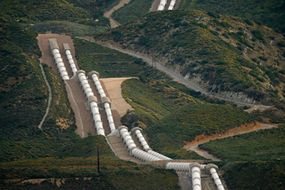
But Los Angeles' growth connected, due in part to the tremendous amount of water available to support the city, and by the early '20s, demand once more exceeded supply. In 1923, just 10 years subsequently the Owens Valley channel was completed, Owens Valley was running dry.
Los Angeles' clamorous demand for water took its toll on Owens Valley. Once the lake started to dry upwards, depleting the fish supply for the region, L.A. went after the groundwater. Despite widespread protest in the valley, culminating in violence in 1924, when residents used dynamite to destroy key points along the aqueduct, the city of L.A. continued to buy upwardly country in the valley to ensure its access to the water. Agriculture in the area suffered and Owens Valley faced a long period of reject.
In 1970, around the same time that 50.A. completed its second aqueduct, this one carrying water from Haiwee Reservoir but south of Owens, conservationists were starting to gain basis in the United States. A series of lawsuits resulted in several agreements betwixt Owens Valley and Los Angeles that have helped Owens Valley to rebuild over fourth dimension. Money supplied past Fifty.A. has congenital fisheries, reservoirs, conservation grounds, wild fauna preserves and groundwater management systems in the valley, which accept brought it back to life, for the most function. And the aqueducts are now a source of green power, besides, supporting several hydroelectric dams.
Despite the controversy that came to surroundings the Los Angeles aqueducts, they are nonetheless a feat of applied science as amazing equally those in ancient Rome. Relying entirely on gravity, the ii L.A. aqueducts today comport about 430 million gallons (one,627.7 megaliters) of water over hundreds of miles into Los Angeles every 24-hour interval. That should keep the urban center hydrated for a little while.
For more than information on aqueducts and related topics, get to the links below.
Related HowStuffWorks Articles
- Will the U.S. be a desert in 50 years?
- Did Nero actually play the fiddle while Rome burned?
- How Water Works
- How Tunnels Work
- How Bridges Work
- How Volcanoes Work
More Keen Links
- Antiquities of Rome: Roman aqueducts
- Los Angeles Department of H2o and Power: History of the L.A. Channel
- UNRV History: Roman Aqueducts
Sources
- Engineering Feats: Roman Aqueducts. TeachingTools. http://www.teachingtools.com/Slinky/aqueduct.html
- History of the LA Aqueduct. Los Angeles Department of Water and Ability. http://wsoweb.ladwp.com/Channel/historyoflaa/index.htm
- Roman aqueducts. Antiquities of Rome. http://world wide web.mariamilani.com/ancient_rome/roman_aqueducts.htm
- Roman Aqueducts. InfoRoma. http://www.inforoma.it/feature.php?lookup=aqueduct
- Roman Aqueducts. SchoolHistory. http://www.schoolhistory.co.uk/year7links/romans/aqueducts.pdf
- Roman Aqueducts. UNRV History. http://www.unrv.com/culture/roman-aqueducts.php
Source: https://science.howstuffworks.com/environmental/green-science/la-ancient-rome2.htm
0 Response to "How To Get To Sofria Aqueduct"
Post a Comment